Trading Drawdown Rules: The Progressive Protocol That Saves Your Account
Every strategy has drawdowns. The question isn't whether you'll face a losing streak — it's whether you'll still have an account when it ends. Here's the protocol.

Trading drawdown is the percentage decline from peak account equity to lowest point during a losing streak that systematically destroys underprepared retail traders. Every trading strategy produces drawdowns — the difference between survival and account destruction lies in having a systematic protocol before the losses begin.
I learned this the hard way. Early in my trading on Gold, I had a solid two months — consistent gains, growing confidence. Then I hit a drawdown. Five losing trades in a row. Instead of following rules (which I didn't have), I increased my position size to recover faster. Three days later I was down 23% from my peak, staring at a hole that would take months to climb out of.
That experience changed everything. Not my strategy — my risk protocol.
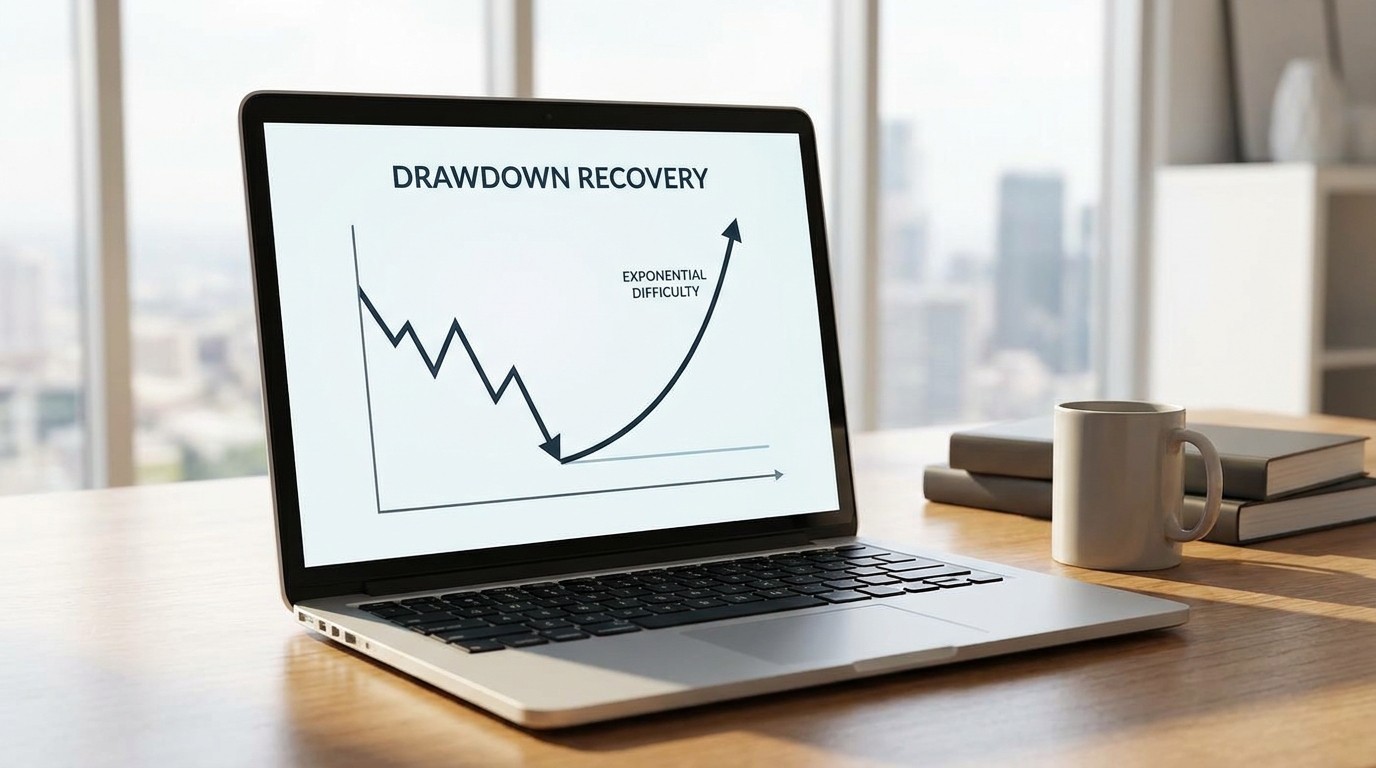
The Math That Should Terrify You
Drawdown recovery is not linear. It's asymmetric, and the deeper you go, the steeper the climb back:
- Lose 5% → need 5.3% to recover
- Lose 10% → need 11.1% to recover
- Lose 20% → need 25% to recover
- Lose 30% → need 42.9% to recover
- Lose 50% → need 100% to recover
At -10%, recovery is tough but realistic within a few weeks of normal trading. At -20%, you're looking at months. At -50%, you need to double your remaining capital — which is nearly impossible under the emotional pressure of having already lost half your account.
The Progressive Drawdown Protocol
Professional traders don't improvise their response to losing streaks. They define exact actions for each level of drawdown before it happens — when they're calm and rational.
Level 1: -3% Daily Loss → Session Closed
Hit 3% loss in a single session? Platform closed. Not "I'll just watch the charts." Closed entirely.
Why 3%? Two bad days at 3% puts you at -6%, which is uncomfortable but recoverable with normal trading. Two bad days at 5% puts you at -10%, and now you're fighting uphill math. The daily circuit breaker keeps single-day damage contained.
Level 2: 3 Consecutive Red Days → Mandatory Day Off
Three losing sessions in a row isn't normal variance for most strategies — it's a signal. Either market conditions have shifted, or your execution is deteriorating under accumulated stress.
Take a full day off. No charts, no analysis, no "just checking." Physical activity, rest, perspective. When you return, trade with minimum position size for your first 3 trades before normalizing.
Level 3: -10% From Equity Peak → Cut Position Size by 50%
This is where most traders make the catastrophic mistake: they increase their size to recover faster. "If I just double up, one good day gets me back to even."
The correct move is the exact opposite. At -10%, reduce your position size by half for a minimum of two weeks.
The logic: smaller size means each loss hurts less psychologically and financially. Less pain means less emotional pressure. Less pressure means better decisions. Better decisions break the losing streak. You're not trading to recover — you're trading to stop the bleeding.
Level 4: -15% From Peak → Back to Demo
This sounds extreme. It's not. At -15%, something in your process is broken. Maybe it's the strategy in current market conditions. Maybe it's your emotional state. Maybe both. You need to diagnose the problem without burning more capital while you figure it out.
Trade demo for one full week using your exact live trading rules. If you're profitable in demo but were losing live, the issue is psychological — the presence of real money is distorting your execution. If you're also losing in demo, market conditions may have changed and your strategy needs adaptation.
Level 5: -20% From Peak → Full Stop
Stop trading entirely. Pull up your journal and review every trade from the past month. Look for patterns in your discipline errors. Discuss with a mentor or trading community. Do not return to live trading until you've identified the specific cause and have a concrete plan to address it.
A 20% loss requires 25% gains to recover — achievable, but only if you stop the bleeding here. Traders who push through -20% without stopping frequently end up at -40% or -50%, where recovery becomes fantasy.

The Concept That Transforms Your Relationship With Losing
There's one number from your backtesting that functions as a psychological anchor during live drawdowns: your strategy's expected maximum drawdown.
When you backtest your method over 50-100 trades (which you should complete before ever going live), one of the key statistics you extract is the maximum drawdown during that period. Say your backtest shows a max drawdown of -12%.
Now you're trading live and you hit -8%. Without the backtest data, this feels like a crisis. With it, you know: this is within normal parameters. The strategy has done this before and recovered. You continue executing your process with confidence.
This is the difference between:
- Expected drawdown: Within historical parameters. Continue executing. The strategy will normalize.
- Anomalous drawdown: Significantly exceeds historical parameters. Stop and investigate. Something has changed.
The Anti-Martingale: Why Pros Reduce Size When Losing
The Martingale approach — doubling your bet after a loss — is how casinos bankrupt gamblers. Yet most traders unconsciously apply it: lose a trade, increase size on the next one to recover.
Professional traders use the opposite approach, Anti-Martingale:
- Winning streak / performing within parameters: Maintain position size or increase slightly using only realized profits — never base capital
- Losing streak / drawdown: Systematically reduce position size, trading smaller until the streak breaks
"But if I reduce size, recovery takes longer!" Yes. That's the point. The priority during a drawdown is survival, not speed. You cannot recover from a blown account. You can always recover from a smaller drawdown with a working strategy and intact capital.
The Emotional Reality of Drawdowns
The protocol is mechanical. The challenge is emotional.
At -10%, cortisol floods your system. Every loss feels amplified. The temptation to freeze (stop trading entirely from fear) or overcompensate (trade bigger from desperation) is overwhelming. Both responses are wrong.
This is why the rules must be written before the drawdown happens. When you're calm, you write the protocol. When you're in the drawdown, you execute the protocol. You don't create new rules under emotional duress.
Two emotional tools that help:
The pre-trade loss acceptance test: Before every trade, look at the dollar amount of your stop loss. Not the percentage — the actual money. Ask: "If I lose this right now, will my heart rate change? Will I feel the urge to revenge trade?" If the answer is yes to either, reduce your size until the answer is no.
The cost-of-business reframe: Professional traders treat losses the way a restaurant owner treats spoiled inventory. It's a predictable operating expense, not a personal failure. The restaurant doesn't close because some food went bad. You don't blow up because some trades hit their stop.
Build Your Protocol Right Now
Don't wait until you're in a losing streak. While you're thinking clearly:
- Define your daily circuit breaker. What's your max daily loss before the session closes? Write the number.
- Define your drawdown levels. What happens at -5%, -10%, -15%, -20%? Write the specific action for each.
- Get your expected drawdown number. If you have 50+ backtested trades, calculate the max drawdown. If you don't have this data yet, that's your first priority before trading live.
Put all of this into your written trading plan. Not in your head — in a document you can read when your judgment is clouded.
The drawdown will come. It always does. The only question is whether you'll navigate it with a protocol or with panic.
The bottom line
Drawdowns separate professional traders from gamblers. Professionals know exactly what they'll do at each level of loss before it happens. They reduce size when losing, not increase it. They treat expected drawdowns as normal business operations and anomalous ones as stop signals.
The math is unforgiving: a 50% loss requires 100% gains to recover. Your survival depends not on avoiding drawdowns — that's impossible — but on having systematic rules that prevent small losses from becoming account killers.
Key takeaways
- Write your drawdown protocol before losses begin — never improvise responses under emotional pressure
- Cut position size by 50% at -10% drawdown, not increase it to recover faster
- Use your strategy's backtested maximum drawdown as a psychological anchor for normal vs. anomalous losses
- Implement daily circuit breakers at -3% to prevent single-session catastrophes from compounding
- Stop trading entirely at -20% drawdown and investigate what broke before returning to live markets
---
TradingMindLab monitors your drawdown in real-time with a Risk Monitor that shows daily P&L, weekly P&L, drawdown from peak, and consecutive losses — all on your dashboard. The platform also runs Monte Carlo simulations on your actual trade history to project the probability and magnitude of future drawdowns. Know your numbers before the market tests them.