How to Stop Revenge Trading: 5 Emotional Traps and a Protocol That Works
You just got stopped out. The trade was clean. What happens in the next 60 seconds will determine whether you're a trader or a gambler. Here's how to stop revenge trading before it drains your account.

Revenge trading is entering positions to recover losses rather than following setup criteria — and it destroys more trading accounts than any bad strategy ever could.
You just got stopped out on Gold. The setup was clean — valid zone, confirmation candle, defined risk. The market went the other way. That's trading.
But here's what actually matters: what you do in the next 60 seconds.
If your hand is already reaching for the mouse to enter another position — bigger this time, because you need to "make it back" — you're about to revenge trade. And revenge trading has ended more trading accounts than any bad strategy ever could.
I know because I've been there. More times than I'd like to admit. At 2am, staring at a Gold chart, entering my fourth trade of the night after three consecutive stops. Not because the setup was there — because my ego couldn't accept closing the day in the red.
That night cost me more than the three losses combined. And it taught me something no indicator or course ever did: the problem wasn't the market. The problem was me.
What Revenge Trading Really Is
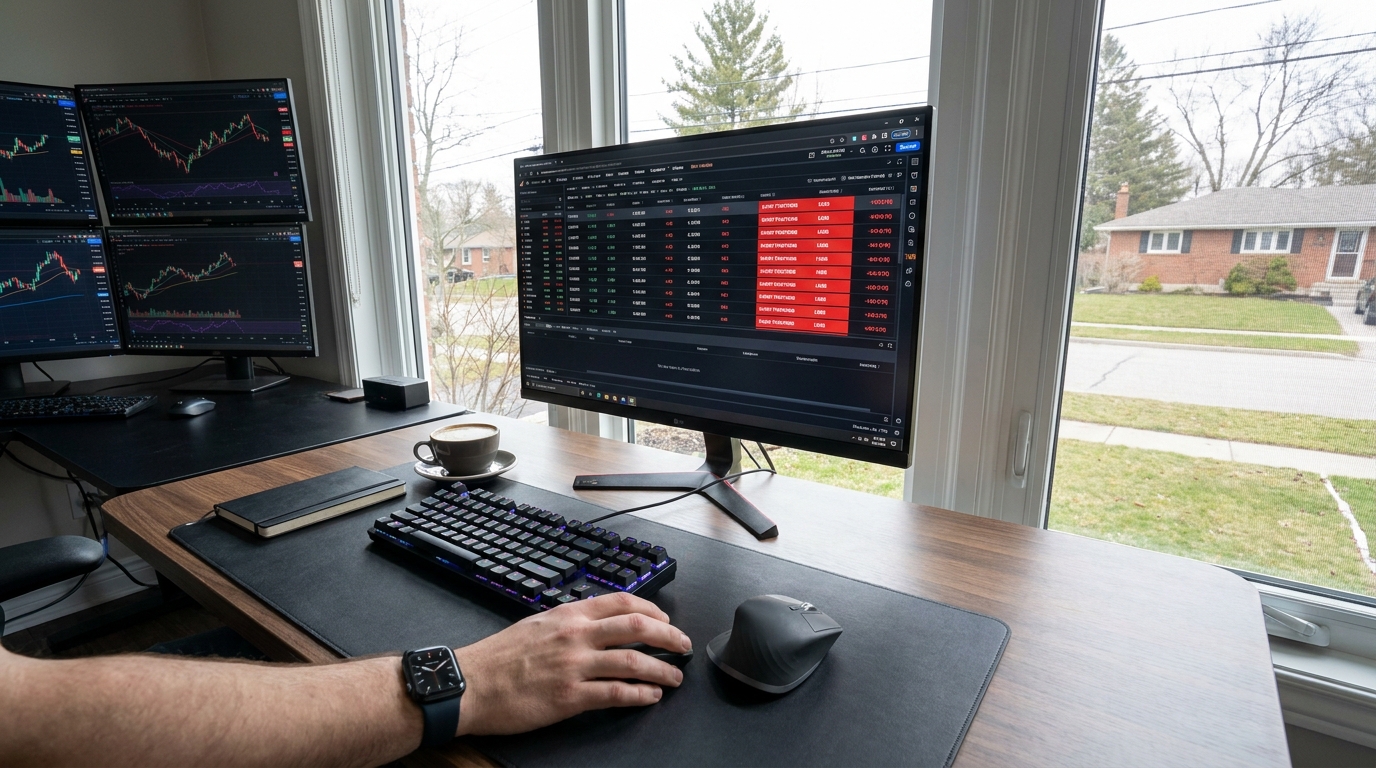
Revenge trading means entering a trade to recover a loss rather than because the setup meets your criteria. The decision to trade was made before you even looked at the chart. Your motivation shifted from analytical to emotional — from "does this setup qualify?" to "I need to get my money back."
The dangerous part is that it doesn't feel irrational in the moment. Your brain constructs a convincing story: "This next one looks solid. I just need one good trade." But the urgency behind that thought has nothing to do with the market and everything to do with your nervous system screaming for relief.
The 5 Emotional Traps That Trigger Revenge Trading
Recognizing these traps in real time — before they become action — is the skill that separates traders who survive from those who don't.
Trap 1: FOMO After a Missed Move
You see a candle explode in the direction you predicted but didn't trade. Your body reacts before your brain catches up — you enter without analysis, driven purely by the fear of missing out. There's no plan, no defined risk, no stop placement logic. Just the desperate feeling that the move is happening without you.
The early warning: You're watching a candle move and feeling physical urgency to click. Your analysis happened after the impulse, not before.
Trap 2: The Ego Wound
You took a stop on a trade where your analysis was correct — the setup was valid, the zone held, but the market needed one more sweep before turning. Your ego interprets this as a personal failure. The next trade becomes about proving you were right, not about following your process.
The early warning: You're thinking about the last trade while looking for the next one. The previous loss is still in your head.
Trap 3: Overtrading on Slow Days
The market is ranging. Nothing is setting up. But you've been staring at charts for two hours and the need to "do something" builds. So you take a trade that wouldn't qualify on any other day — just to feel productive. Fifteen trades later, you've turned a flat day into a losing one.
The early warning: You're bored. You're scrolling between timeframes looking for any excuse to enter.
Trap 4: The Hope Syndrome
You're in a losing position. The stop is right there, a few pips away. Instead of letting it trigger, you move it. Or you remove it entirely. You stare at the screen hoping — literally hoping — the price will come back to breakeven. At this point you've stopped trading and started gambling.
The early warning: You're fixated on a single position and haven't looked at the bigger picture in minutes.
Trap 5: Analysis Paralysis From Indicator Overload
This one is the opposite of overtrading but equally destructive. After a painful loss, your brain seeks protection through control. You add a new indicator. Then another filter. Then another confirmation. Each addition seems rational. The result: six indicators on your chart, all giving conflicting signals, and you never enter because there's always one that disagrees.
The early warning: You've modified your setup more than twice in the last month. You keep adding tools instead of executing.
The Protocol: How to Actually Stop
Willpower doesn't work here. When your amygdala hijacks your prefrontal cortex, rational thought goes offline. You need mechanical rules that activate before the emotional spiral takes hold.
Step 1: The Body Scan (Before Every Trade)
Before clicking anything, scan your body for 10 seconds. Shoulders tense? Heart rate elevated? Jaw clenched? Shallow breathing? Urgency in your stomach?
These physical signals mean your fight-or-flight system is active. Your reptilian brain is in control. In that state, the quality of your decisions is objectively compromised — regardless of what the chart shows.
If you feel any of these, do not trade. Set a 15-minute timer, step away from the screen, and reassess.
Step 2: The Circuit Breaker
Define a hard daily loss limit — not a guideline, an absolute rule. Hit -2% or -3% for the day? Session over. Close the platform entirely. Not "I'll just watch." Close it.
Also set an emotional circuit breaker. Rate yourself 1-10 before each session (1 = calm, 10 = agitated). If you're above 7, the session is closed — regardless of whether you're in profit, loss, or flat. Euphoria after a big win is just as dangerous as frustration after a loss.
Step 3: The 15-Minute Rule
After any loss, do not enter a new trade for 15 minutes. During those 15 minutes, open your trading journal and write three things:
- What am I feeling physically right now?
- Which emotional trap am I recognizing?
- What would have happened if I had waited?
This interrupts the loss-reaction loop. Fifteen minutes is usually enough for the cortisol spike to subside and for your prefrontal cortex to come back online.
Step 4: Classify Every Loss
Immediately after each losing trade, categorize it:
- Good loss: Process followed 100%. Valid setup, correct size, stop respected. The market moved against you. This is the cost of doing business — like rent for a store.
- Discipline error: You deviated from the plan. Moved the stop. Entered without confirmation. Increased size impulsively. Traded outside your session.
Good losses need no correction — the process worked, the outcome was just unfavorable this time. Discipline errors need analysis. Not of the strategy, but of the behavior.
The goal is not zero losses. The goal is zero discipline errors.
Step 5: Track and Measure
In your journal, tag every trade that was motivated by recovery rather than by setup quality. After 30 days, compare: what's the win rate on revenge trades vs. planned trades? What's the average loss size?
The data will be more persuasive than anything I can write here. Most traders who do this exercise find that their revenge trades have a win rate below 25% and an average loss 2-3x larger than their planned trades.

The Deeper Reframe
Revenge trading isn't a strategy problem. It's a relationship-with-loss problem.
Every trader who survives long enough learns to treat losses as operating expenses. A restaurant doesn't close because some food spoiled. A business doesn't shut down because a marketing campaign underperformed. And a trader doesn't blow up their account because a valid setup hit its stop loss.
The loss was planned, sized correctly, and expected. You move on to the next valid setup — whenever it appears, even if that's tomorrow.
The best trade you'll ever make is the one you didn't take when your emotions were screaming at you to enter.
What to Do Right Now
If you recognized yourself in any of these traps, here are three things you can do today:
- Write down your circuit breaker. Pick a daily loss limit and an emotional threshold. Commit to it for 30 days.
- Start classifying losses. After your next losing trade, immediately write: good loss or discipline error. Do this for every single loss.
- Apply the 15-minute rule. After your next stop, set a timer. Write in your journal before touching the chart again.
The cycle doesn't break by itself. A structured protocol, applied consistently, rewires how you respond to losses. That's not motivation — that's neuroscience.
The bottom line
Revenge trading stems from treating losses as personal failures instead of business expenses. Your trading account isn't a reflection of your worth — it's a tool for executing a process.
The protocol works because it interrupts the emotional spiral before it reaches the click stage. Body scans catch physical urgency. Circuit breakers enforce discipline when willpower fails. The 15-minute rule creates space between feeling and action.
---
TradingMindLab tracks your emotional state before, during, and after every trade — then automatically correlates it with your results. The revenge trading patterns hiding in plain sight? The platform surfaces them for you in your weekly AI report.