Best Risk Management Tool for Trading
Your position sizing calculator won't save you when emotions take over. The best risk management tool for trading isn't software—it's a systematic approach that forces discipline when your lizard brain screams to break the rules.
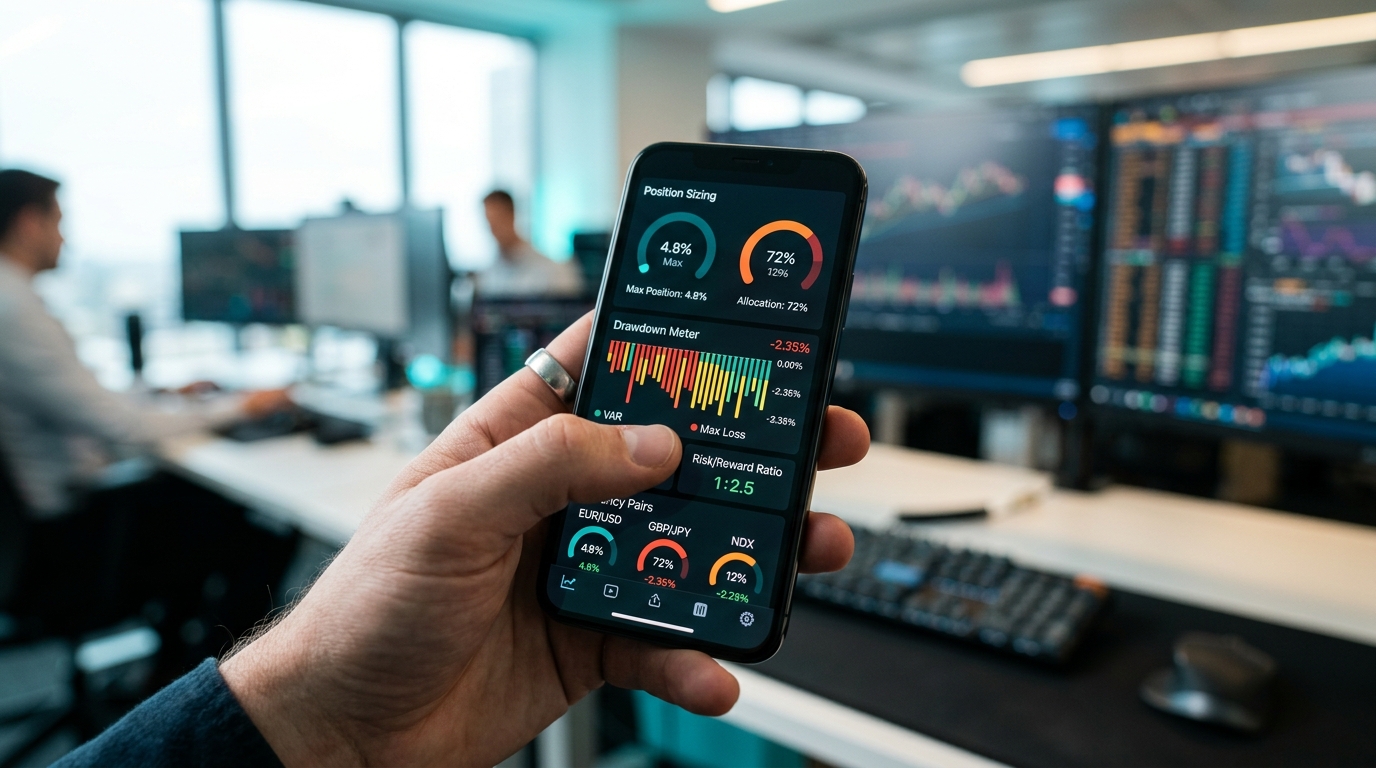
Best risk management tool for trading is a systematic position sizing framework combined with real-time emotional tracking that prevents catastrophic losses through disciplined execution protocols. Most traders focus on technical indicators while ignoring the psychological component that destroys more accounts than bad entries ever will.
Why Traditional Risk Tools Fail Under Pressure
I've watched countless traders blow accounts despite having stop losses, position sizing calculators, and risk-reward ratios mapped out perfectly. The problem isn't the math—it's the human executing it.
When Gold dropped 40 points in fifteen minutes last month, every risk rule I'd programmed into my head evaporated. My 1% position size rule became "just this once, 3% because I'm sure it'll bounce." The stop loss shifted from 10 points to 25 because "it needs room to breathe."
Traditional risk management tools treat trading like a purely mathematical exercise. They calculate your position size based on account balance and desired risk percentage. They set alerts when you're approaching daily loss limits. But they can't force you to follow through when your P&L is bleeding red and revenge trading feels like the only way out.

The Systematic Framework That Actually Works
Real risk management operates on three levels: mechanical, behavioral, and systematic recovery.
Mechanical Level: Your position size is calculated before market open based on predetermined criteria. Not during a trade, not when you "see an opportunity," but during your pre-market routine when emotions are neutral. For Nasdaq futures, my maximum risk per trade is 0.5% of account balance, period. No exceptions for "high probability setups."
Behavioral Level: You track your emotional state before, during, and after every trade. This isn't touchy-feely journaling—it's data collection. When I'm frustrated (emotional rating 7+), my stop losses get moved. When I'm overconfident (rating 2 or below), I increase position sizes. The pattern becomes visible only when tracked consistently.
Systematic Recovery: When you hit predetermined drawdown levels, your position sizes automatically reduce. Not based on how you feel about the market, but based on mathematical protocols established when you weren't losing money.
Last week I caught myself planning to double my usual Gold position because "the setup was too obvious." My emotional tracking showed confidence level 9/10—historically my worst performing psychological state. The systematic framework forced me to take the standard 0.5% risk instead of the 1.5% my emotions demanded.
Emotional State Tracking: The Missing Component
Most risk management focuses exclusively on the financial metrics while ignoring the psychological ones. Your emotional state predicts your risk-taking behavior more accurately than any technical setup.
I track five emotional states before every trade: confidence (1-10), frustration (1-10), clarity (1-10), pressure (1-10), and previous trade impact (1-10). When any combination hits predetermined thresholds, position sizes get reduced or trades get skipped entirely.
The data reveals patterns that pure financial tracking misses. My worst trades consistently occur when confidence is above 8 or frustration is above 6. The best risk management tool isn't stopping me from taking bad setups—it's stopping me from taking good setups when I'm in bad psychological condition.
A platform like TradingMindLab automatically correlates your emotional ratings with trade outcomes, revealing which psychological states produce your worst risk-adjusted returns. The insight is often counterintuitive: your most confident trades might be your most dangerous.
Position Sizing Under Real Market Conditions
Position sizing calculators work perfectly in theory and fail spectacularly in practice. The best risk management tool adapts position sizes based on current account conditions, not just static percentages.
Standard advice says risk 1-2% per trade. But 2% risk when you're up 15% for the month hits differently than 2% risk when you're down 8%. Your psychological relationship with that money changes, which means your execution changes.
My framework adjusts position sizes based on three factors:
Current Drawdown Level: When account is down more than 5%, position sizes drop to 0.25%. When up more than 10%, they stay at 0.5%. This prevents both revenge trading during losses and overconfidence during winning streaks.
Recent Trade Sequence: After two consecutive losses, position size drops 50% for the next three trades regardless of setup quality. After four consecutive wins, same reduction to prevent overconfidence.
Market Volatility Context: During high-volatility sessions (Gold moving 30+ points intraday), position sizes reduce automatically because stop distances increase. Your 1% risk at 10-point stops becomes 3% risk when stops need to be 30 points.
Two weeks ago, Nasdaq opened with a 150-point gap down. My standard position size would have been appropriate for normal conditions, but the volatility adjustment cut it in half. That decision saved me from what became a 200-point whipsaw day.
Recovery Protocols: What Happens After Losses
The best risk management tool prepares for losses before they happen. Most traders develop recovery strategies after blowing up, when emotions are highest and judgment is worst.
My recovery protocol activates automatically at predetermined drawdown levels:
5% Drawdown: Position sizes reduce to 0.25%, maximum two trades per day, mandatory 24-hour break after any loss.
10% Drawdown: Trading stops completely for 48 hours, followed by paper trading only until account recovers to 7% drawdown.
15% Drawdown: Complete trading halt, account review, and strategy audit before any live positions.
These aren't suggestions I consider during drawdowns—they're non-negotiable protocols established during profitable periods. The decision to reduce risk isn't made when you're losing money and desperate to recover. It's made when you're thinking clearly and can plan objectively.

Last month I hit the 5% drawdown trigger after a series of Nasdaq trades went against me. The protocol forced me to paper trade for two days instead of jumping back in with larger positions. During that break, I identified the psychological pattern causing the losses: overtrading after strong morning sessions. Without the forced pause, I would have kept bleeding money while trying to "trade my way back."
The Integration Challenge: Making It Stick
The gap between knowing risk management principles and executing them consistently separates professional traders from everyone else. The best tool means nothing if you don't use it during the moments that matter.
Consistency comes from removing decision-making during high-stress situations. Your position size, stop loss distance, and maximum daily loss aren't calculated in real-time—they're predetermined during your planning routine when emotions are neutral.
I use a pre-market checklist that includes emotional state assessment, position size calculation based on current account conditions, and maximum loss tolerance for the session. These decisions are made before I see any price action, removing the temptation to adjust based on how "obvious" a setup appears.
The psychological challenge is following your own rules when they feel restrictive. Every trader has experienced the frustration of missing a "perfect" setup because their position size was too small or they'd hit their daily loss limit. The best risk management tool forces you to prioritize long-term survival over short-term opportunities.
Key takeaways
- Combine mechanical position sizing with real-time emotional tracking for complete risk management
- Establish position size and risk parameters during neutral emotional states, not during live trading
- Track emotional patterns that correlate with your worst risk-adjusted returns
- Implement automatic position size reductions based on account drawdown levels
- Create recovery protocols before you need them, when judgment isn't impaired by losses